Problem
A scaling native team was losing roughly one full headcount every week to manual campaign setup.
Every launch required the same sequence. Templating in a spreadsheet. Source-specific naming conventions, each one slightly different. Tracker setup with URLs that had to be exactly right. Creative uploads, repeated across four traffic networks. Each step was a place a mistake could happen, and each mistake compounded by the time anyone noticed.
By the time we were called in, the team had three open positions for “media buying coordinators” — people whose job would be to do the setup. The CFO was unhappy. The media buyers were unhappy. The campaigns were waiting.
System
We replaced the setup process with a launch pipeline. A single specification — written once per offer — drives campaign creation across all four sources at once. Source-aware naming. Tracking-ready URLs. Creative bundles assigned by rule. Budget guards applied automatically.
The work of figuring out how a launch should look stays with the media buyer. The work of executing the same launch sequence forty times in a row goes to the system. The media buyer stops typing and starts thinking.
How the pipeline is built isn’t the interesting part. What’s interesting is what’s no longer in the team’s hands: the parts that were repetitive, error-prone, and never benefited from human judgment in the first place.
Outcome
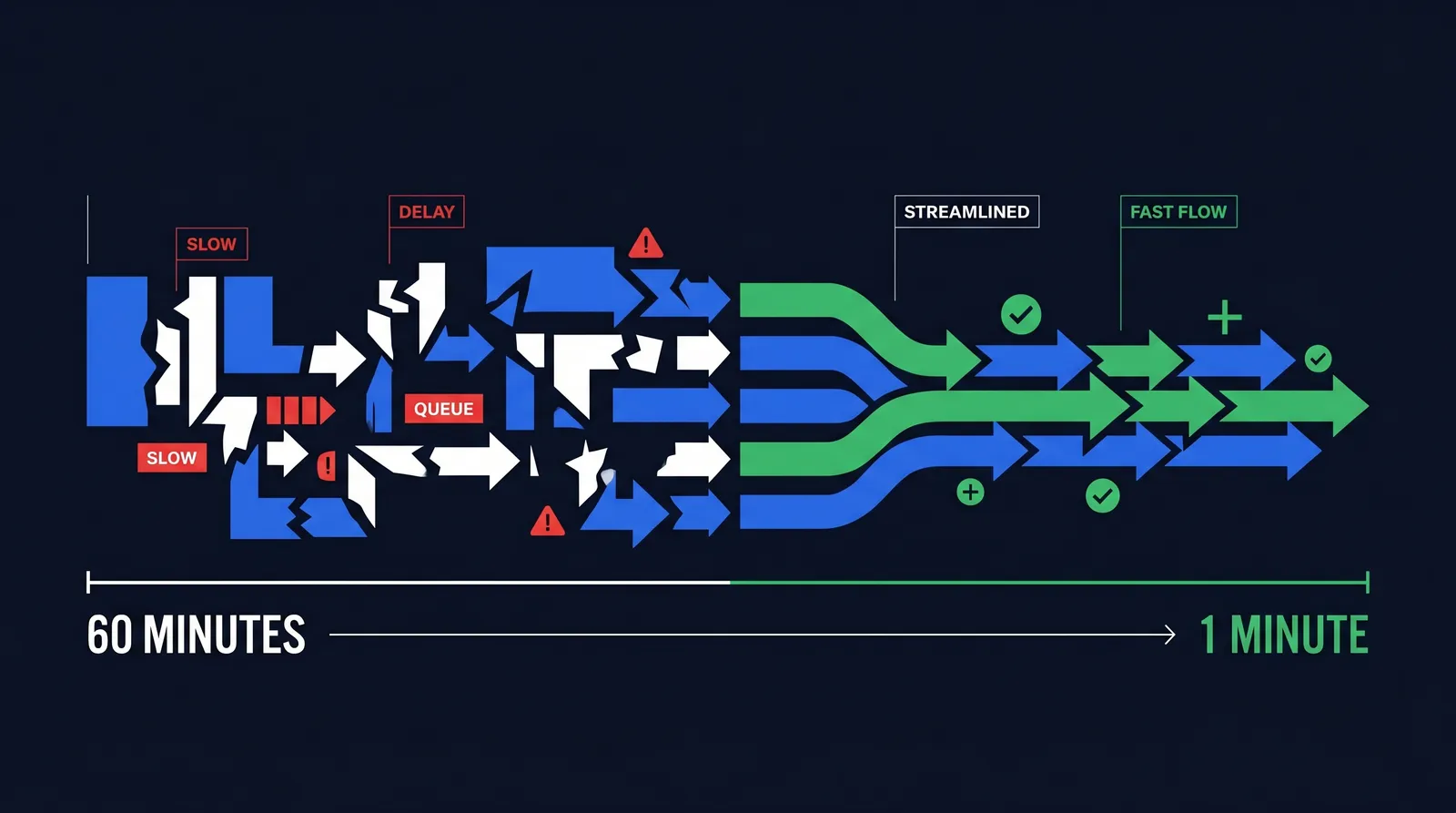
Launch time dropped from about an hour to under two minutes. The team’s tracking errors collapsed from roughly eight a week to near zero. Within sixty days, launch volume had grown from eighty per week to over two hundred per week — with no additional headcount.
The three open coordinator positions were never filled. The CFO got that conversation closed. The media buyers got their afternoons back. The campaigns stopped waiting.
The throughput change is what gets talked about. The interesting part is what the team did with the time. They started testing more aggressively. They started looking at creative performance the same week instead of two weeks later. The operation began compounding in a way it hadn’t been before. That part is harder to put in a number, but it’s the part that mattered.
Get case study breakdowns like this
One email when we publish. No spam, unsubscribe anytime. By subscribing you agree to our Privacy Policy.