Problem
The team’s review cadence was once a day, at the morning standup. Losing placements got caught — but only after they’d burned for twelve to eighteen hours.
The math was uncomfortable. Estimated daily loss to placements that should have been cut within hours: somewhere between three and five thousand dollars. Across the year, that was a senior media buyer’s salary going up in smoke on bid math that everyone knew, in principle, how to fix.
The team had built two previous auto-cut systems internally. Both got turned off. Both had killed scaling winners. The media buyers stopped trusting them.
System
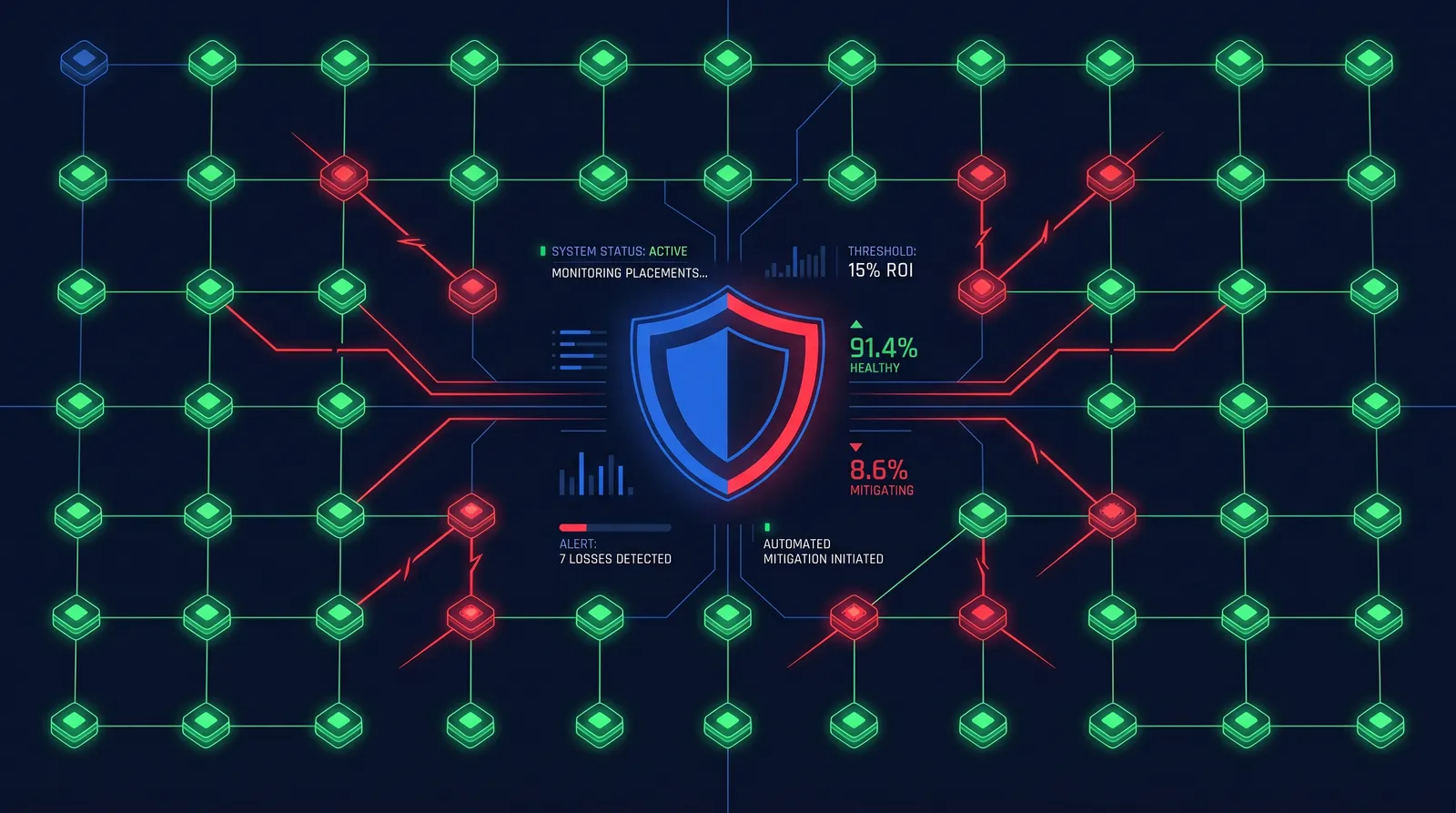
We shipped a new auto-cut layer with one principle the previous attempts had skipped: don’t act on placements that haven’t been observed enough to judge.
The system warms up. It models the variance of EPV at the placement level. It cuts only when it can do so with confidence. The threshold isn’t a single number; it’s a policy that respects warmup, sample size, and the specific shape of variance in the vertical.
What that looks like in detail isn’t the part that’s portable. The principle is. The teams we’ve worked with on this all want the same property: a system that doesn’t kill the placements that would have come good. The policy that produces that property has to be tuned per operation. We do the tuning as part of the work.
The team’s media buyers still own cut decisions on placements outside the system’s confidence band. The system handles the obvious ones. The media buyers handle the judgment calls. That split is what we mean when we say automation should respect operator policy.
Outcome
Thirteen placements got paused on day one, before the morning standup. Roughly thirty-four hundred dollars a day saved on the first day. The recurring savings ran at similar levels across the next quarter.
The more important number is the one that wasn’t there: zero scaling winners killed prematurely. Over ninety days, the system never cut a placement that subsequently came back into profit. That number is what made the system trustable. Without it, the team would have turned this one off too.
The media buyers didn’t lose work. They moved up the stack. Manual loss-hunting was replaced by manual scaling-evaluation. The hours that used to be spent finding losers got reinvested in finding winners.
Get case study breakdowns like this
One email when we publish. No spam, unsubscribe anytime. By subscribing you agree to our Privacy Policy.