Problem
The team was running competitive intelligence the way most teams do. Three commercial spy tools. Each one had a slightly different angle on the market. Together, they still missed the things that mattered.
Coverage was uneven. The redirect chains behind competitors’ ads were unresolved — the tools showed an ad and a destination URL, but the actual funnel sitting between the click and the conversion was opaque. The team was making decisions on screenshots someone had pasted into Slack.
The team’s lead asked us: “If we had this information properly, what would change?” That turned out to be the right question to be asking.
System
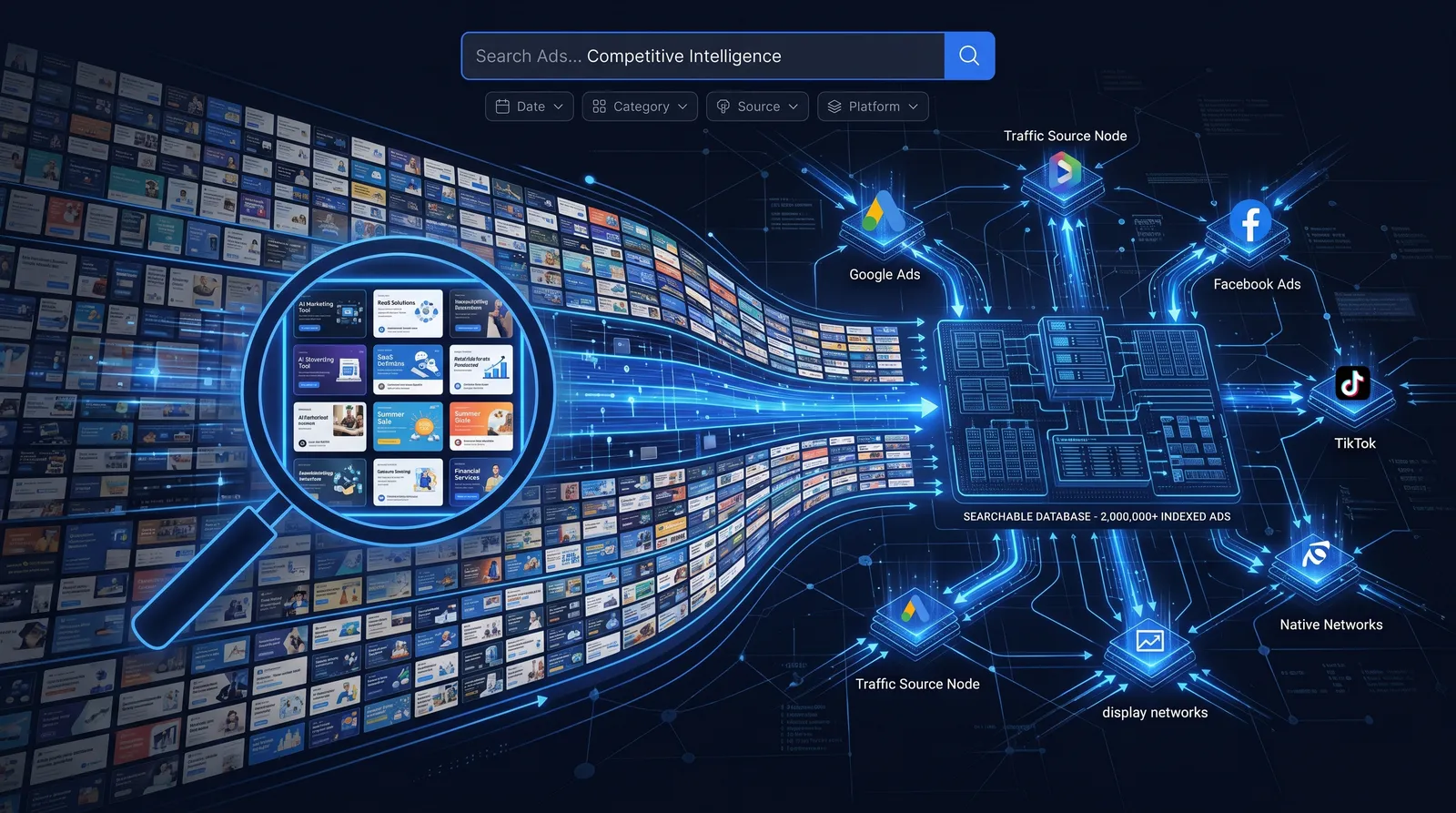
We built a private indexing layer for the verticals the team was buying in. Crawlers across the networks that mattered. A decoder that walked the redirect chains far enough to surface the actual offer endpoints. An index that the team could query the same way they queried their own tracker.
How that decoder works is the part of the project we don’t write down publicly. Redirect patterns change. The approach changes too. Whatever we ship has a shelf life measured in months, and protecting that work is part of why it’s worth what it costs.
The visible shape of the system, from the team’s side, is simple. They get a queryable index of what their named competitors are running, refreshed continuously, with alerts pushed to their ops channel when something material changes. The rest is hidden infrastructure.
Outcome
The three commercial subscriptions got cancelled. That alone freed up enough budget to justify the build.
What the team got back, beyond the cost saving, was visibility into the part of the market that the off-the-shelf tools couldn’t show them. They surfaced angles competitors were running for short windows before killing them — angles that would have been invisible on any commercial dashboard. They started reacting in hours instead of weeks.
The change in the operation was bigger than the change in any specific number. The team stopped treating competitive intelligence as something that happened to them and started treating it as something they ran.
Get case study breakdowns like this
One email when we publish. No spam, unsubscribe anytime. By subscribing you agree to our Privacy Policy.