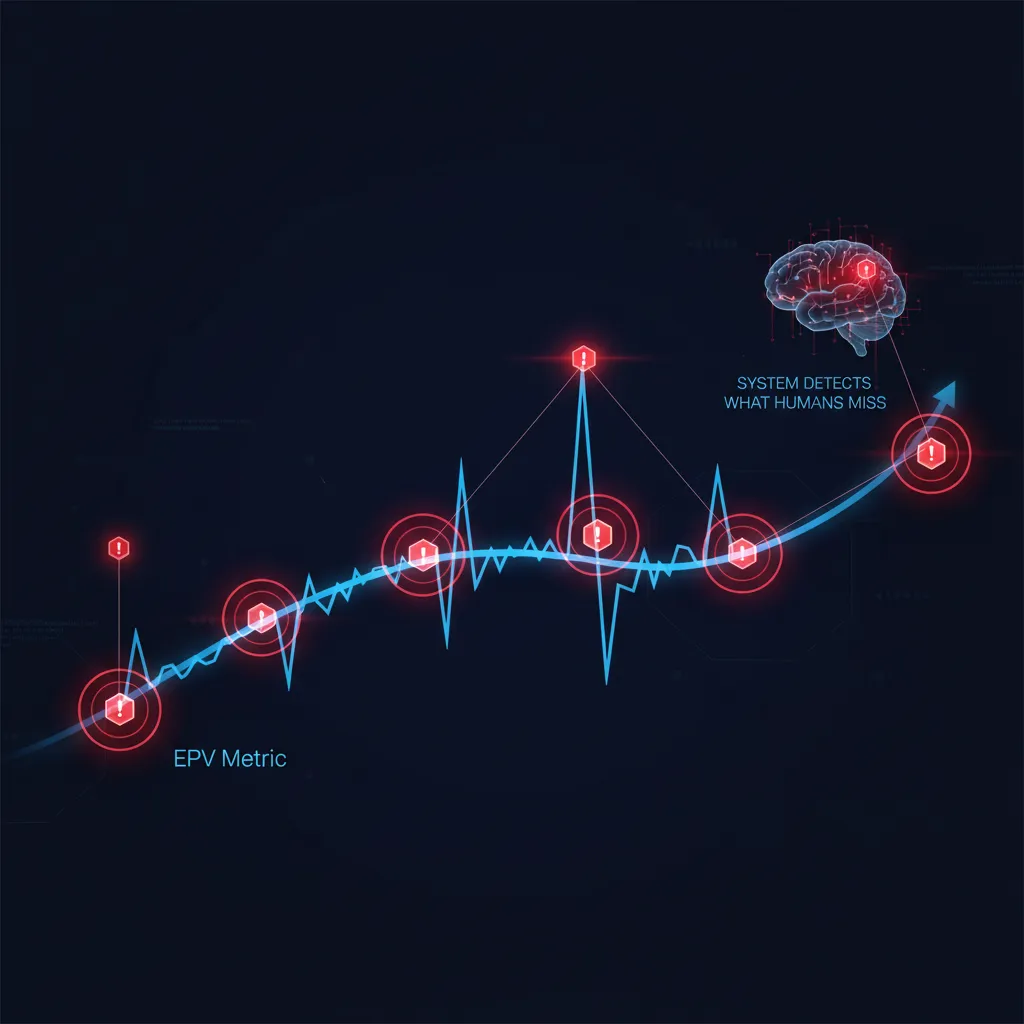
Voluum, RedTrack, BinomTrack. All of them show you the current EPV. None of them tell you that the EPV on your top campaign just shifted, in a way that’s statistically real, over the last four hours.
You notice it tomorrow morning. You’ve spent four thousand dollars on a campaign that’s quietly broken. Maybe the network shaved. Maybe the offer changed payouts. Maybe a tracking endpoint silently started failing. Whatever the cause, you found out too late.
This is the gap between dashboards and alerting. Trackers were built to report. Alerting is a different discipline.
What you’re actually trying to detect
A few signals matter more than the rest.
The first is EPV drift on a campaign that’s been stable. Sustained, real, not a noise spike. The cause varies — shave, offer issue, creative fatigue — but the signal looks the same from outside, and the cost compounds the same way.
The second is conversion rate shape changes across placements. Your average might be flat while the distribution underneath is moving. A campaign with steady EPV that’s secretly running on a smaller set of placements than yesterday is broken in a way the headline numbers won’t show.
The third is volume drops. A tracker that’s silently dropping ten percent of clicks because of a postback bug doesn’t tell you. Your dashboard just shows fewer clicks. You assume the campaign cooled off.
The first kind catches operational problems. The second catches geographic and demographic shifts. The third catches infrastructure breaks. All three are worth a few hours of engineering to wire up.
Why “alert when X is below Y” doesn’t work
The first version of an anomaly detector is a static threshold. It fires constantly during normal seasonality. People mute the channel. The system becomes a worse version of doing nothing — you’re paying engineering for an alert nobody reads.
What works in practice is a comparison against the campaign’s own recent behavior, with the seasonality factored out. Same hour of week, recent rolling window, control band around the expected value. Most of the noise disappears. What’s left correlates well with real operational events.
We won’t lay out the specific baseline math here. The details matter and they take a while to tune for a specific operation. The principle is portable across stacks. The settings aren’t.
What a working alert layer changes about the team
A well-tuned anomaly layer fires a handful of times per week. Every alert maps to a real event the operator wants to know about. The first time someone catches a shave at 2pm instead of finding it the next morning, the system has paid for itself.
The deeper shift is in how the team operates. People stop watching dashboards. The dashboard is for inspection, not surveillance. The system surveils. The operator inspects when called. That’s how you scale operations without scaling headcount — by stopping the activity that didn’t need a human in the first place.
— AffiliateTech Engineering