Every affiliate operation we’ve worked with has the same story. They started with spreadsheets. Outgrew them. Tried off-the-shelf tools — a BI platform for analytics, a project management tool for campaign tracking, a generic CMS for landing pages. And eventually realized that none of these tools understand how affiliate marketing actually works.
This isn’t a criticism of those tools. They’re built for different economics.
Different economics, different tools
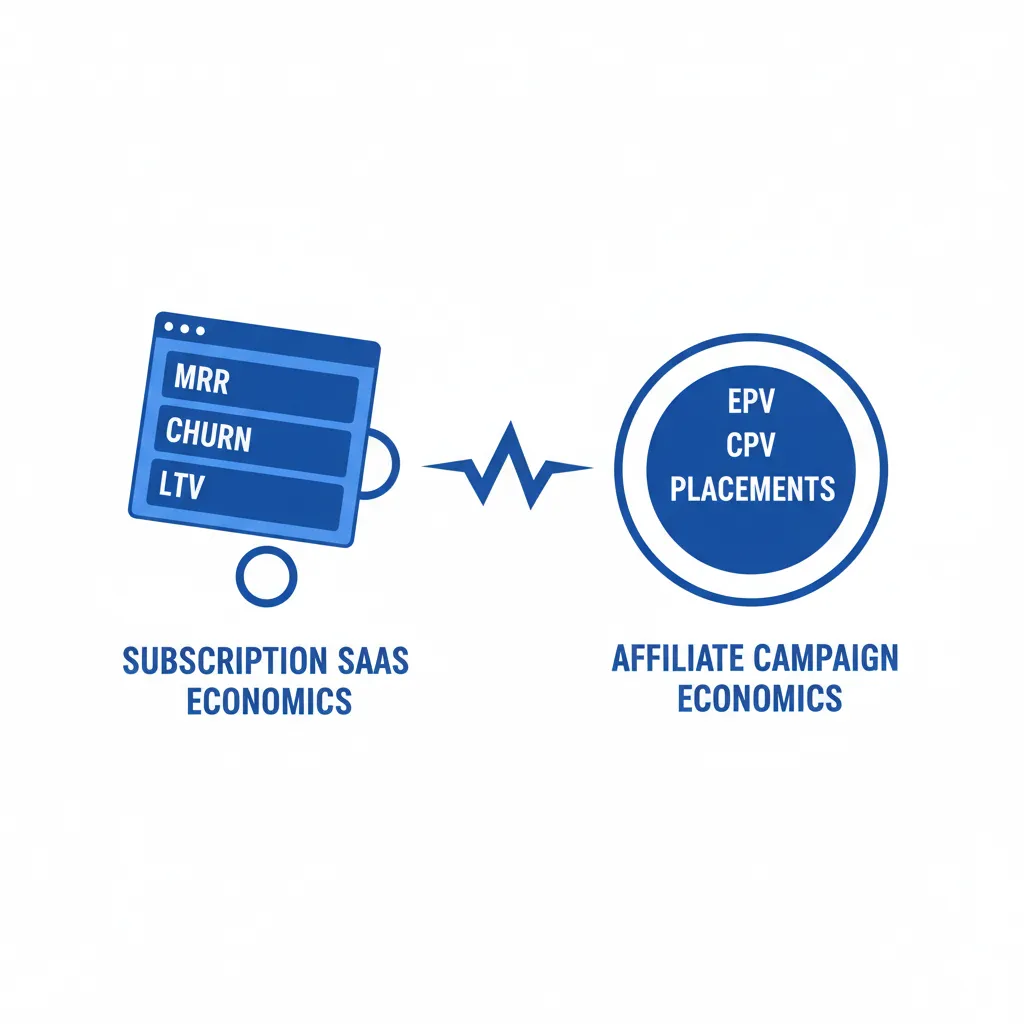
Subscription SaaS companies measure MRR, churn, and LTV. Their analytics tools are built around those metrics. Their dashboards show monthly cohort retention and annual revenue growth.
Affiliate marketing measures EPV (earnings per visit), CPV (cost per visit), and daily profit by placement. The relevant time horizon isn’t monthly — it’s daily, sometimes hourly. A placement that was profitable at 9am can be bleeding by 2pm. An offer that converted yesterday can get pulled by the network today.
When you try to force affiliate data into tools built for subscription metrics, you get dashboards that technically work but don’t answer the questions operators actually ask: “What’s bleeding right now?” “Which placements should I cut?” “What’s my EPV trend on this source this week?”
What affiliate infrastructure actually needs
After a decade of building tools for affiliate operations, we’ve identified what the infrastructure layer needs to do — and it’s different from what generic tools provide.
Placement-level granularity. Generic analytics tools aggregate by campaign or channel. Affiliate operations need to see individual placement performance within a campaign on a specific traffic source. The decision to cut or scale happens at the placement level, not the campaign level.
Offer rotation awareness. Affiliate campaigns often rotate between multiple offers with different payouts, different conversion rates, and different weight distributions. Your analytics need to understand that one campaign can serve five different offers and that performance needs to be measured per-offer, not just per-campaign.
Traffic source API integration. Each major traffic source — Google, Facebook, Taboola, Outbrain, MGID, RevContent — has its own API, its own campaign structure, its own naming conventions, and its own reporting quirks. A tool that integrates with one doesn’t automatically work with another. We’ve built API integrations for each, and each one required source-specific engineering.
Tracker-first architecture. In affiliate marketing, the tracker (Voluum, RedTrack) is the source of truth for conversion data. Every tool in the stack needs to talk to the tracker, not around it. Generic tools that want to be the source of truth create data conflicts.
Real-time economics. Monthly reporting is a rearview mirror. Affiliate operations need daily — sometimes hourly — visibility into profitability. Anomaly detection needs to fire within hours, not after a weekly report is compiled.
What we built instead
We didn’t set out to build a product company. We set out to solve real problems for affiliate companies. But every time we tried to use an off-the-shelf tool, we hit the same wall: it didn’t understand affiliate economics.
So we built campaign dashboards that think in EPV and daily breakdowns. We built launch automation that knows how each traffic source’s API works. We built creative management that tracks performance at the asset level across sources. We built auto-cut systems that understand placement-level warmup windows.
Every tool we built exists because the off-the-shelf version either didn’t exist for affiliate marketing or didn’t understand affiliate economics well enough to be useful.
The infrastructure gap in the ecosystem
This isn’t just our problem. Every affiliate operation at scale — agencies running traffic, networks managing affiliates, advertisers tracking lead quality — faces the same infrastructure gap. The tools that exist are either generic (built for different economics) or manual (spreadsheets, scripts, tribal knowledge).
The affiliate marketing ecosystem generates billions in revenue annually. The infrastructure layer that supports it is still mostly held together with duct tape. That’s the gap we’re building into.