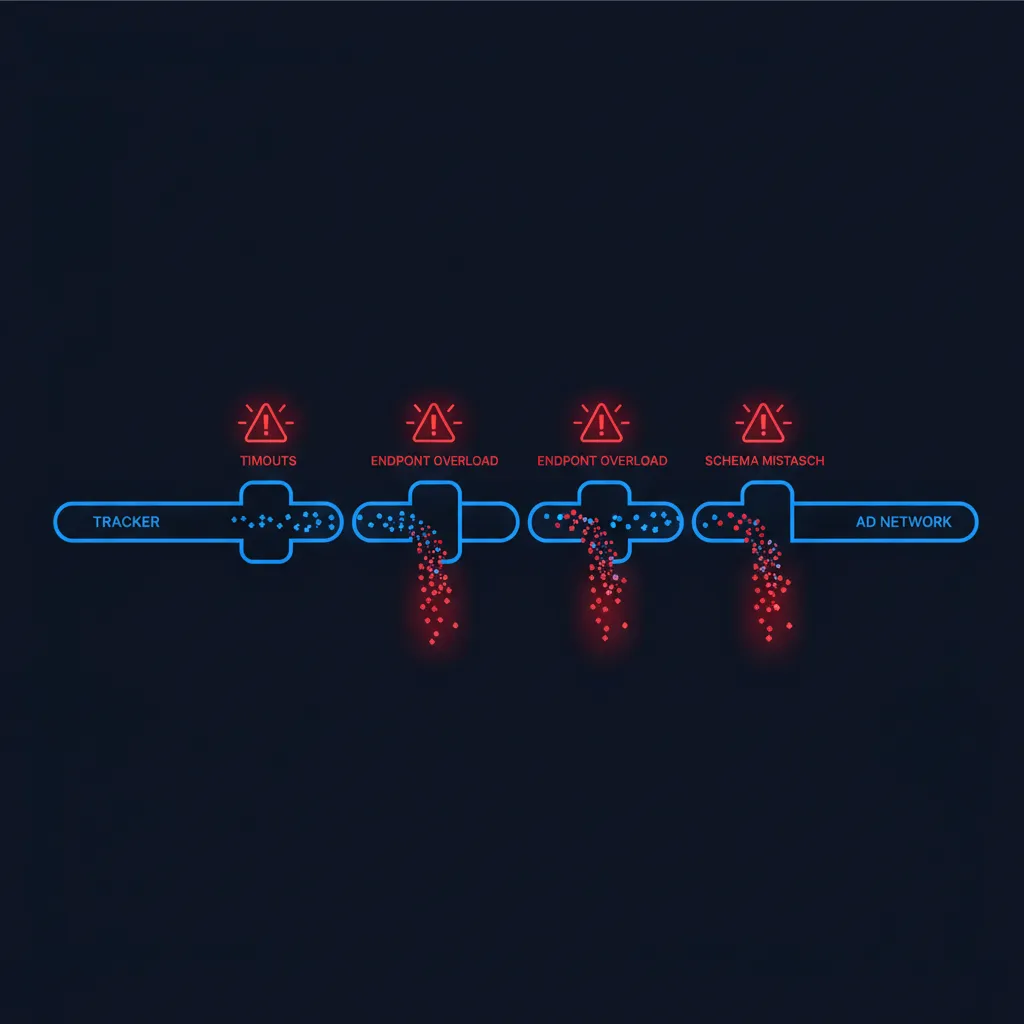
Most affiliate stacks have a quiet failure mode in their postback layer. It loses roughly seven percent of conversions before they’re ever attributed. The conversions are real. They happen on the network’s side. They just don’t make it back to your tracker in a usable form.
You don’t notice this until you audit. Most teams never audit, because nothing visibly breaks. The dashboard looks fine. The reports add up. The conversions are gone.
What we see when we look
When we instrument the postback layer, the losses fall into a handful of buckets. The biggest one is timeouts — postbacks that left the network’s server but didn’t reach your tracker inside the network’s retry window. The second biggest is your endpoint being briefly under load. The third is schema mismatches that fail silently. The fourth is dedup logic deciding two real conversions are duplicates.
You can argue about the exact percentages. We’ve seen the same shape across stacks. The mix shifts. The total loss does not.
These are all recoverable. The network tried to tell you. The information exists. Your stack didn’t catch it.
Why this is harder than it looks
The instinct is to fix the primary postback. Make it faster. Make it more reliable. Reduce schema bugs.
That works for the bottom two-thirds of the loss. It does nothing for the top third, because the top third is failures the network already gave up on. Your tracker is the place where retries don’t happen.
So the actual problem isn’t reliability. It’s that you have one source of truth for an event that needs multiple. Conversions are too valuable to attribute through a single delivery channel. The teams that solve this stop treating postbacks as authoritative and start treating them as one signal among several.
What “several” looks like, exactly, is the part we don’t write down in public. The shape of the solution involves redundancy patterns and reconciliation timing that take a couple of months to get right in production. The first version usually catches most of what was being lost. The last twenty percent of the recovery is where the work is.
What it costs you to not fix this
A few things compound, all bad.
You’re under-attributing your top campaigns by some non-trivial amount. Their actual ROI is higher than your dashboard shows. You might be cutting things you shouldn’t.
You’re paying networks for conversions you’ll never see. The networks know — they track delivery success on their side. Your reputation as an affiliate accrues to your attribution accuracy, not just your spend.
Compliance and finance teams eventually find the gap. The conversation that follows isn’t fun.
If you’re running at over thirty thousand dollars a month in spend without redundancy in this layer, the postback architecture is almost certainly the highest-leverage piece of your stack to fix this quarter. The fix isn’t a feature. It’s a discipline applied across the right surfaces.
The teams that operate at scale have done this. The teams that haven’t, leak.
— AffiliateTech Engineering