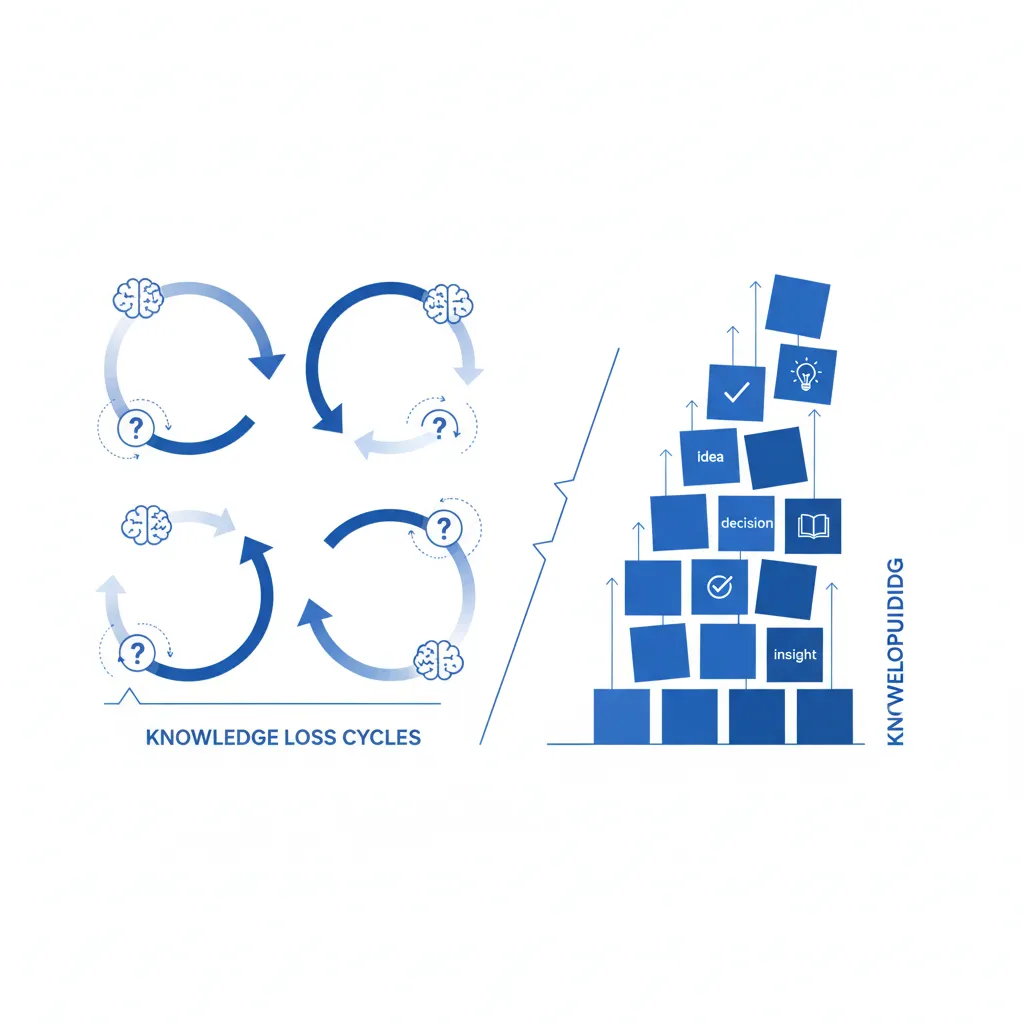
A new media buyer joins your team. You spend an hour explaining how to launch a campaign. They take notes. Six months later, the next new hire joins, and one of your existing media buyers — not you — spends an hour explaining the same thing. Same notes. Same blind spots.
This is the cycle. Most teams don’t notice they’re in it until they try to scale and the math stops working.
The usual explanation is “we need better documentation” or “our SOPs are out of date.” Both miss the real problem. Documentation isn’t broken. It was never going to fix this.
Here is what is happening: every learning your team produces lives in two places when it’s made. It lives in the head of the person who learned it, and it lives in the moment they used it. When a media buyer figures out the right bid step for a scaling placement, that isn’t an idea. It’s an action. They didn’t write a doc. They changed a bid. The lesson sits where the action happened.
Three months later, when a different media buyer faces the same kind of decision, the lesson isn’t where they’re looking. It’s not in the wiki. It’s not in the standup notes. It’s in someone else’s head. And that person doesn’t remember it as a lesson — they remember it as “what I do.”
This is the compounding problem. Not “we don’t write things down.” More like: we don’t have a system that remembers what we did the last two hundred times we faced this.
The shape of it
Once you see it, every team has the same tells.
The “we already tried that” moment. Someone proposes a test. A senior media buyer says “we did that in March, it didn’t work.” Nobody remembers why. Nobody can find the data. The test gets run again anyway. Or worse — skipped on faith.
The rediscovery cycle. The same insights come up every four to six months as if for the first time. A pattern about how a vertical performs in a specific hour window gets found, used, then forgotten when the media buyer rotates off. Six months later, the same pattern gets found again, with the same satisfaction.
The onboarding tax. Every new hire walks the same path to figure out what works in your operation. You can’t make the path shorter because the answers aren’t in the system. They’re in the heads of people who don’t have time — or the right framing — to teach.
The departure event. Someone leaves. Three months later, you realize a whole vertical’s memory left with them. You don’t know what you lost because the loss is invisible until you need that one thing.
Decision archaeology. A budget cap on a campaign is set to a specific number. No one remembers why. It’s been that number for eight months. Was it the offer’s payout cap? An LP capacity limit? A compliance review from last quarter? Nobody knows. The team is afraid to change it.
If any of those felt familiar, you don’t have a documentation problem. You have a memory problem.
Three decisions that separate compounding teams from maintaining ones
Teams that compound look at this differently. They’ve made three decisions most teams haven’t.
Where should learning live? Not in people. Not in docs. Downstream of both. If the lesson is “don’t bid above a certain level on placements with low warmup,” that lesson belongs inside the launch flow itself — not in a Notion page media buyers theoretically read on Mondays. Where the lesson sits matters more than how it’s written.
What’s worth capturing? Not everything. Campaign-level learnings are usually noise. Team-level learnings are usually too generic to use. The layer that matters is decisions — the specific judgments that, when encoded once, save the team from making the same call fifty more times. Most teams capture the wrong layer and wonder why their knowledge base doesn’t help.
What’s the cost of capture? Every attempt to capture learning adds friction to the work. Too much friction and the team works around it. Too little and nothing sticks. The teams that get this right make capture a side effect of action — not a separate task. The moment you ask someone to “write up what they learned,” you’ve already lost most of the learning.
These three decisions are where the work is. The way you build them changes by tracker, by stack, by team. The decisions don’t.
What it costs to keep operating without this
Three things compound, all bad.
Your headcount becomes your throughput. You can’t grow operations without hiring, because each new person needs six months of internal apprenticeship before they’re productive. Adding people doesn’t add capacity. It adds onboarding load.
Senior operators become hostages. Losing one is painful. You start running your team less like a team and more like a fragile network. The wrong person quitting at the wrong time costs you a quarter. Nobody says this out loud. Everyone keeps the chart in their head.
New offers, new sources, new geos all get slower to test, because every cycle starts cold. The team that’s ten cycles ahead of yours has memory you don’t. They’re not ahead because they work harder. They’re ahead because their systems already know what yours haven’t learned yet.
What compounding actually looks like
Teams that compound look different from teams that don’t. Not in the way most people guess. They don’t have better wikis. They don’t have stricter SOPs. They don’t have cleaner writeups.
What they have is fewer decisions to make per launch, because past decisions are already inside the defaults, the guards, the workflows. The system says “this is how we launch native on a finance vertical in tier-1,” and most of the conversation that used to happen is over. The media buyer’s job is the part that needs human judgment. The part that doesn’t is handled by the system that remembers.
That’s compounding. Not knowledge growth. Decision growth. The lessons your team learned last quarter are doing work this quarter, on their own, without anyone needing to remember them.
The real question — the one that actually matters — is where your team’s memory lives. If it lives in heads, you’re maintaining. If it lives in docs, you’re maintaining slower. If it lives in the systems your team uses every day, you’re compounding.
We’ve watched teams shrink three-week onboarding into three days by moving their twenty most-repeated decisions out of the wiki and into the launch flow itself. The lesson wasn’t better docs. It was that the docs were in the wrong place.
Most performance teams are maintaining and calling it scaling. The gap between those two takes about eighteen months to become hard to close.
— AffiliateTech Engineering