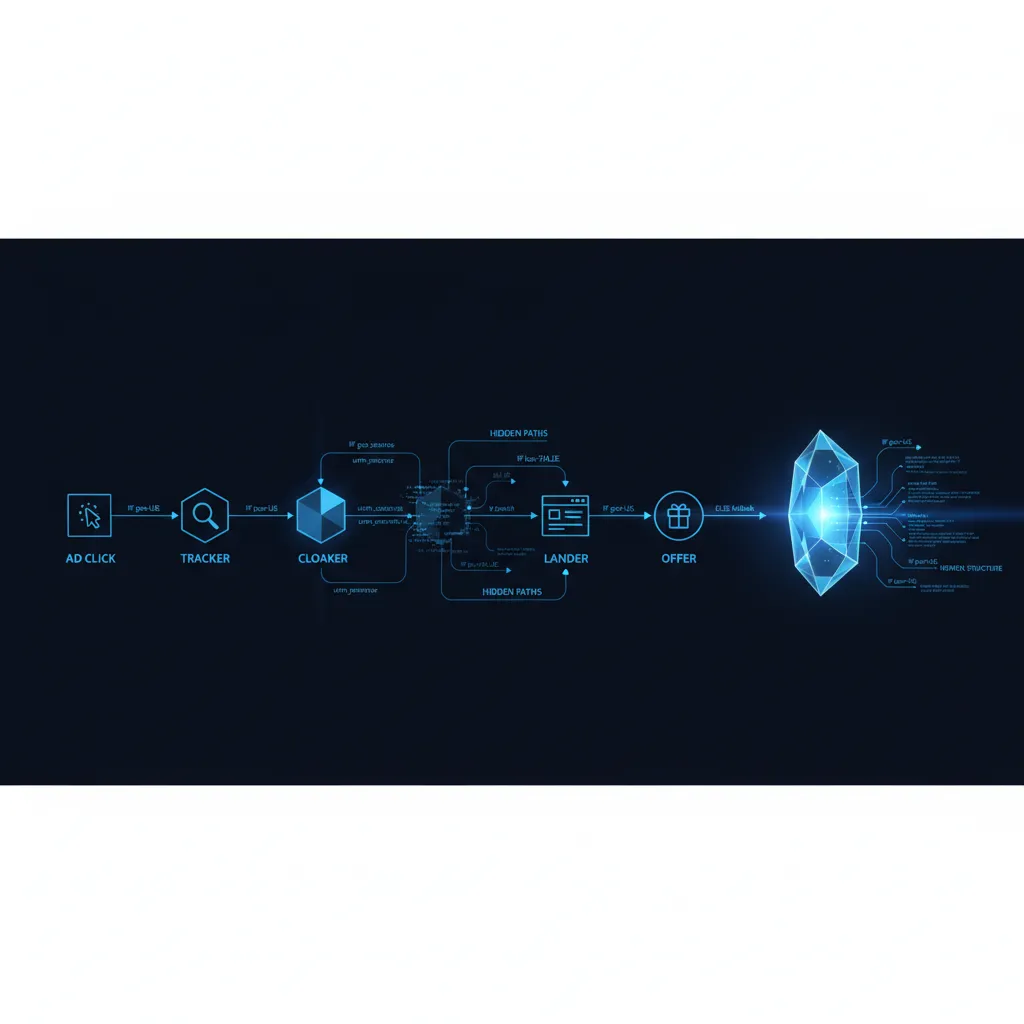
Commercial spy tools are good at surfacing ads. They’re not very good at telling you anything about the funnel behind the ad. That’s a problem, because the ad is the part that’s easiest to copy. The funnel is the part that’s hard to figure out.
Knowing that a competitor is running a creative tells you almost nothing. Knowing which affiliate network they’re routing through, what offer endpoint the click resolves to, what their bridge page looks like in your geography — that tells you something. Most teams don’t have that visibility, because nothing on a typical dashboard provides it.
Why this part is hard
A modern affiliate funnel has several hops between the click and the conversion. Each hop can do its own thing — set cookies, fingerprint the browser, conditionally redirect based on geography or device. Curling the URL gives you nothing. Hitting the URL with a generic crawler gets you a filtered version designed for compliance scanners.
The only way to see what a competitor is actually running is to behave like the kind of visitor they want to see. That’s harder than it sounds. The competitors who are sophisticated about their funnels are also sophisticated about who they let see them.
How you solve that — the specific approach for navigating complex redirect structures, normalizing offer endpoints, attributing chains to specific affiliate networks — is the part we don’t write down. It’s the work, and the work changes as redirect patterns change. The underlying capability is portable; the implementation has a shelf life measured in months.
What you can actually do with it
When the decoding works, you can answer questions that aren’t on any commercial dashboard.
You can see when a competitor first pushed a creative. You can see when they killed it. You can see what they replaced it with. You can see which networks they’re routing through, what offer endpoint they’re landing on, and whether their funnel structure looks like a bridge-page-then-offer or a direct-to-LP shape.
None of these answers tell you whether their campaign is profitable. They tell you what’s available to test. Which is enough. The teams that operate well in competitive verticals run a continuous low-grade scan of what their named competitors are doing. They catch new angles within a day or two of those angles going live. The teams that don’t, find out a month later.
When this is worth building
Below thirty thousand dollars a month in spend, off-the-shelf spy tools are usually fine. You’re not yet at a volume where missing one angle costs you serious money. The economics don’t justify the work.
Above that, the economics flip. Missing a good angle for a month, on a campaign that should have been profitable, is more expensive than building the decoding capability. The teams we work with at that volume have all gone through this realization. They built it. Or they bought it from someone who built it. Either way, they stopped relying on tools that only show them the ad.
The part that’s hidden from your competitors is the most valuable part to see. That’s not a coincidence.
— AffiliateTech Engineering